OBI ITS — Full-Stack Competition Platform
A production-grade competition platform built entirely solo for the **Olympiade of Biology ITS ** — handling participant registration, secure authentication, and real-time admin management from a single codebase.
Stack
Next.js · TypeScript · Express.js · Prisma · MongoDB · TailwindCSS · Vercel
What It Does
Three core systems make the whole platform run:
- Registration flow — participants fill a multi-step form; data is validated server-side, stored in MongoDB, and confirmation is sent automatically
- Auth & session management — JWT-based authentication with protected routes on both the Next.js frontend and Express.js API; role-based access separates participants from admins
- Admin panel — committee members can view, filter, and export all registration data; status updates propagate instantly without a page refresh
No third-party registration tools. No spreadsheet chaos. Everything in one place.
Development Timeline
Built across roughly 6 weeks as a solo developer, handling design, frontend, backend, and deployment in parallel.
| Phase | Scope | Duration |
|---|---|---|
| Design & Planning | Wireframes, DB schema, API contract | Week 1 |
| Frontend | Landing page, registration form, participant dashboard | Week 2–3 |
| Backend | Auth, registration API, admin endpoints | Week 3–4 |
| Integration & Testing | End-to-end flows, edge case handling | Week 5 |
| Deployment & Hardening | Vercel deploy, env config, load testing | Week 6 |
The biggest time sink was authentication — getting JWT refresh tokens, protected route middleware, and session persistence right across both Next.js and Express took longer than expected.
Key Technical Decisions
Prisma over raw MongoDB driver — Prisma's type-safe query builder eliminated an entire class of runtime errors. Autocomplete on database queries in TypeScript is genuinely a productivity multiplier when working alone.
Server-side rendering for the landing page — Next.js SSR meant the public-facing pages were fully indexed by search engines and loaded fast on first visit, without any client-side data fetching delays.
Role-based middleware on the API — rather than checking roles in every route handler, a single requireRole('admin') middleware wraps all admin routes. Clean, auditable, easy to extend.
TailwindCSS for speed — no time to maintain a separate design system solo. Tailwind's utility classes let UI decisions happen inline without context-switching to CSS files.
Challenges
Designing the full system architecture alone. Usually there's a senior to sanity-check decisions. Here, every call — database schema, API structure, auth strategy — was mine. Getting it wrong early would cascade.
Securing authentication without a library like NextAuth. Rolling a custom JWT implementation forced a deep understanding of token expiry, refresh flows, and CSRF risks that would have been abstracted away otherwise.
Meeting a hard deadline with a shifting spec. Registration requirements changed twice. The flexible MongoDB schema absorbed the data-layer changes; the real challenge was keeping the frontend form and backend validation in sync each time.
Testing alone. No QA, no second pair of eyes. Built a manual test checklist and ran through it after every major change — tedious, but it caught real bugs before the platform went live.
What I Learned
- Building full-stack solo forces a systems-level view that feature work on a team rarely requires — you feel every dependency between layers
- TypeScript across the entire stack (frontend + backend) is worth the setup cost; the compiler catches integration bugs that would otherwise only appear at runtime
- Database schema design deserves more upfront time than UI — changing a form is easy, migrating production data is not
- Deployment is not the finish line; monitoring, error logging, and having a rollback plan matter more once real users are hitting the system
Results
- ✅ Platform live and handling real participant registrations for OBI ITS
- ✅ 500+ participants registered through the platform without data loss or downtime
- ✅ Zero authentication vulnerabilities reported during the competition period
- ✅ Admin panel reduced committee workload from manual spreadsheet tracking to a single dashboard
- ✅ First solo full-stack production deployment — frontend, backend, database, and infrastructure all self-managed
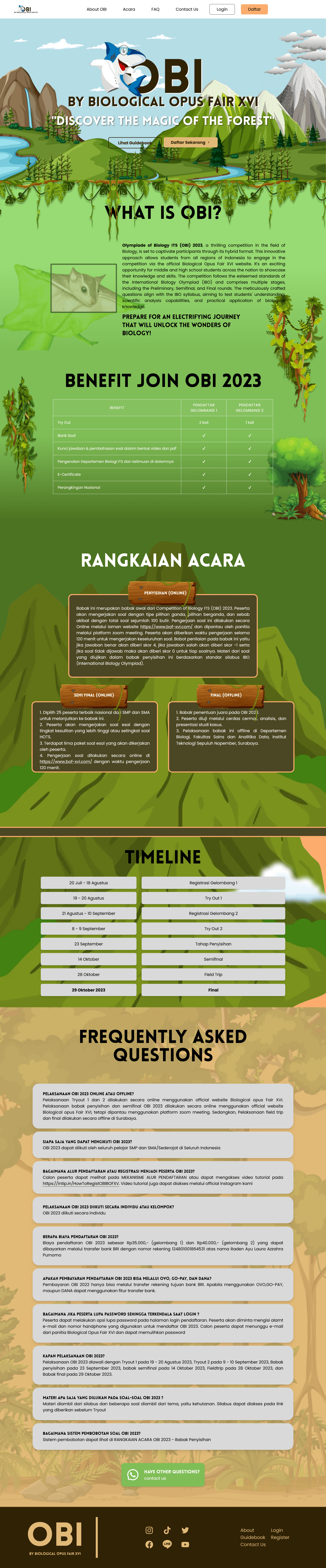 OBI ITS Landing Page