Concert Ticket Marketplace on Ethereum Layer-2
A fully decentralized ticket marketplace where concert organizers mint NFT tickets on Polygon zkEVM — no middlemen, no fakes, no scalping.
Stack
Solidity · Next.js · Hardhat · ethers.js · Polygon zkEVM · IPFS · MetaMask · ERC-721
What It Does
Three core smart contract functions drive the whole lifecycle:
createEvent— organizer submits event details (name, date, capacity, price); contract stores it immutably and returns a unique event IDpurchaseTicket— buyer sends ETH, contract atomically mints an ERC-721 NFT to their wallet; metadata stored on IPFSuseTicket— event staff enters the Token ID; contract verifies ownership, marks ticket as used, then burns the NFT to prevent reuse
Everything is on-chain. No backend, no trusted third party.
Why Polygon zkEVM
Ethereum mainnet is too expensive for high-volume ticket sales. Polygon zkEVM solves this with ZK Rollups — transactions execute off-chain, a single ZK-SNARK proof is submitted to Ethereum L1 for verification. The result: same security guarantees, drastically lower cost.
Tested across three testnets to find the right tradeoff:
| Network | Gas Price | Deploy Cost | Deploy Time |
|---|---|---|---|
| Polygon zkEVM Cardona | 0.01 Gwei | 0.0000525 ETH | 13.2s |
| Polygon PoS Amoy | 37.57 Gwei | 0.1974 POL | 5.8s |
| Ethereum Sepolia | 21.77 Gwei | 0.0001144 ETH | 8.7s |
Cardona wins on cost (~375× cheaper than Sepolia per operation). Amoy wins on speed. For a marketplace that needs to scale, cost efficiency matters more.
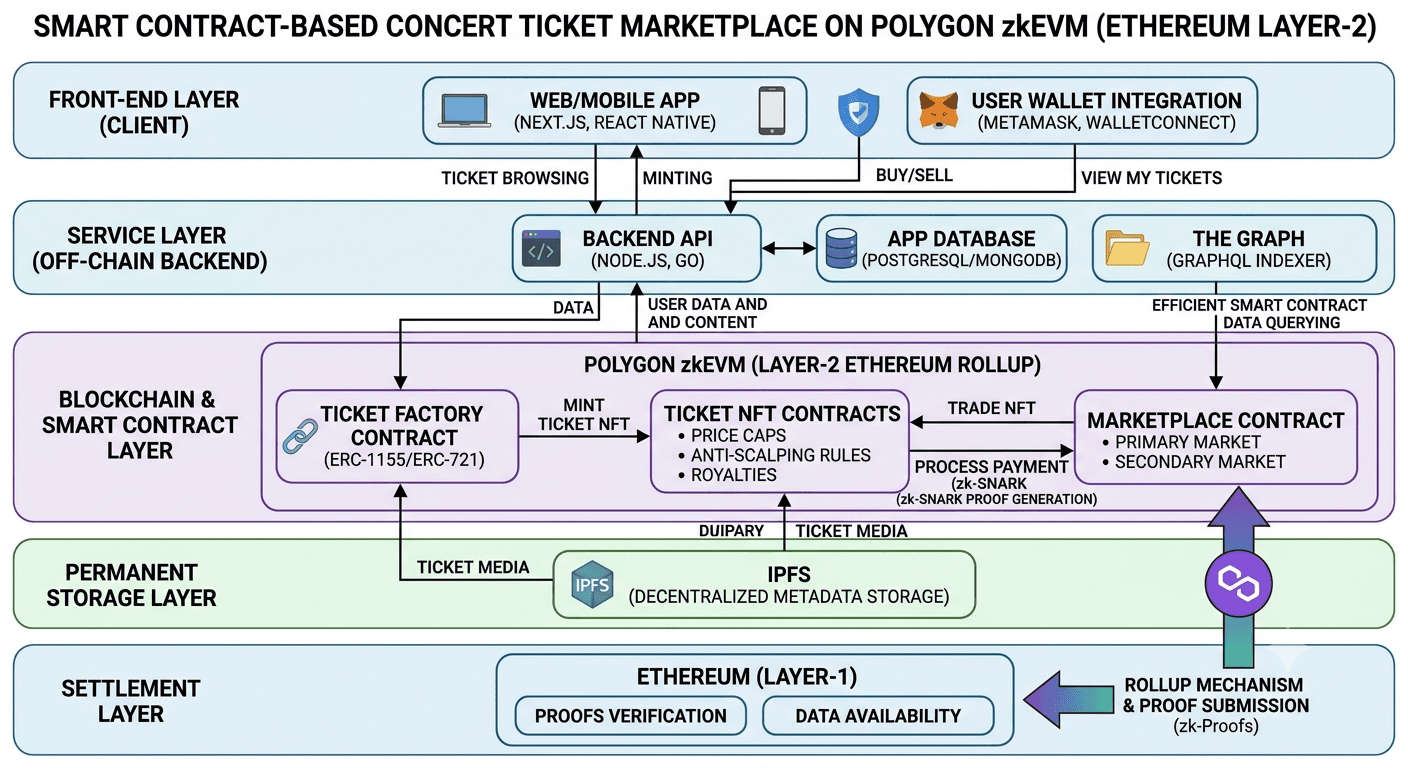 Arch overview
Performance Testing
Ran four load test scenarios on Cardona. Key findings:
Ramp-Up Purchase Test (2→10 concurrent transactions)
- 100% success rate across all 150 transactions
- TPS scaled linearly from 0.99 → 4.65 as concurrency increased
- Average response time stayed under 50ms even at peak load
- Peak burst TPS: 285.7
Sustained Load Test (8 concurrent, 80 transactions, 20s)
- Still 100% success rate
- The network got faster over time — TPS improved from 175 → 292 as it warmed up
- Final batch: 25ms duration, 23ms response time
- 66.8% TPS improvement from first batch to last
The warm-up effect was consistent across all tests: first-batch gas usage runs ~20% higher (cold start overhead), then stabilizes at ~332,619 gas for subsequent purchases.
What I Learned
- ZK-SNARK verification adds compute overhead that explains Cardona's slower confirmation time — it's the price of cryptographic security without a trusted party
- The first NFT mint always costs more gas than subsequent ones; state initialization is expensive, subsequent operations reuse cached state
- Polygon zkEVM's self-optimizing behavior under sustained load was surprising — it wasn't designed behavior I explicitly coded, it's the network adapting
- Building on L2 forces you to think about finality differently: zkEVM gives instant finality once the proof is verified, vs. optimistic rollups that need a challenge window
- IPFS for metadata + on-chain ownership is the right split — heavy data off-chain, proof of ownership immutably on-chain
Results
- ✅ Full ticket lifecycle working end-to-end on Polygon zkEVM Cardona testnet
- ✅ 100% transaction success rate under all load scenarios
- ✅ Ticket purchase cost: 0.00000393 ETH (~$0.01) vs. comparable L1 costs orders of magnitude higher
- ✅ Peak throughput: 320 TPS under sustained load
- ✅ Zero double-spend — burn mechanism prevents any ticket from being used twice
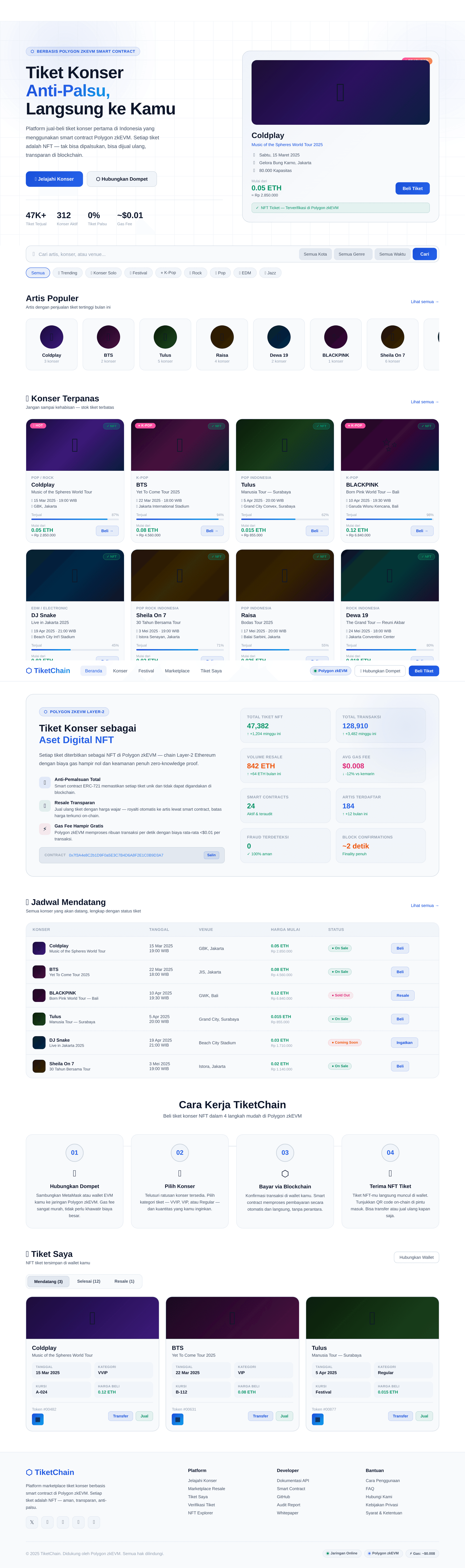 UI overview